
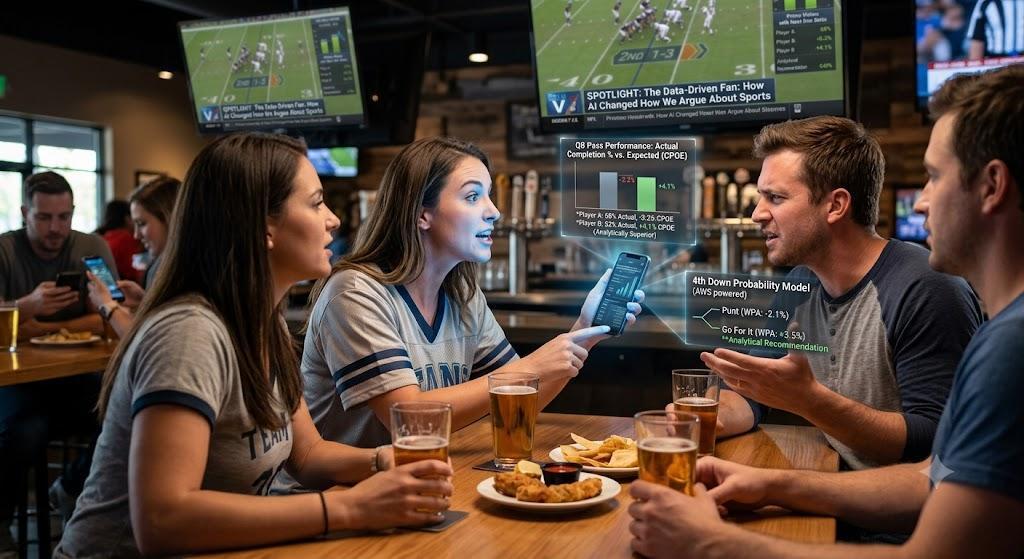
The Death of the "Eye Test"
For over a century, the anatomy of a sports argument was completely subjective. Spectators gathered in local dives to debate athletes using a vocabulary of pure vibes: grit, momentum, and the nebulous "eye test." Evaluation of a quarterback's decision-making relied heavily on outcome bias. Look closer today, and you realize that era is entirely dead. By 2026, the casual argument at the local bar has mutated into a rigorous statistical defense. Fans no longer rely on visceral reactions. The modern discourse is ruthlessly dominated by AI predictive models, tracking telemetry, and complex probability matrices.
Let's be real. The guy three stools down isn't just yelling at the TV anymore. He is aggressively refreshing upcoming NFL matchups and odds to mathematically humiliate his buddy about a blown second-half spread. The psychology here is pretty straightforward. You bring empirical market realities to the bar, and suddenly you are the sharp guy in the room; nobody wants to argue with someone who natively speaks probability matrix.
The AWS Wiretap: Turning Sweat into Spatial Geometry
You have to examine the stadium hardware to truly understand this cultural shift. American football operated as a simple "box score game" for the vast majority of its history. Traditional statistics aggregated discrete outcomes at the end of a play, tracking things like total passing yards and aggregate tackles. These historical metrics were absolute garbage. They stripped athletic events of their contextual significance completely, ignoring the speed and spatial dynamics of the other twenty-one players on the field.
Football actually flipped on its head a few years back thanks to the NFL teaming up with Amazon Web Services. They rolled out the Next Gen Stats (NGS) platform, dragging the sport kicking and screaming out of the dark ages of manual charting directly into the realm of automated, high-frequency telemetry. Every NFL venue now houses twenty to thirty ultra-wideband receivers mounted throughout the stadium architecture. Every piece of stadium hardware talks to RFID tags jammed into player shoulder pads—even the officials, the first-down chains, and the actual football have them. One single Sunday afternoon creates an absolute avalanche of raw data points.
Machine learning pipelines, humming quietly on remote servers, convert these raw coordinates into contextualized insights. Data scientists extract advanced metrics that completely supplant traditional box scores. Let's say some guy tries to argue a quarterback is elite based purely on a high completion percentage. The guy next to him will immediately pull up a negative Completion Percentage Over Expected (CPOE). Math shuts that argument down instantly, proving the quarterback just benefits from cowardly, short-yardage play-calling rather than possessing any actual arm talent.
The Expected Points Cult
Sports arguments today require absolute fluency in an entirely new lexicon. Expected Points Added (EPA) reigns supreme in this space. This specific value function is the absolute bedrock for player evaluation and strategic in-game decision-making.
Analysts build expected points models by assessing a highly specific game-state vector. This vector tracks the current down, distance to gain, exact field position, and time remaining in the half. Algorithms then calculate the historical average of net points scored from that exact situation. Picture an offense staring down first-and-ten at their own twenty-yard line. The algorithm looks at that setup and tosses out an Expected Points value of +0.5. Then the quarterback airs it out for forty yards, setting up shop at the opponent's forty; that brand new game-state is suddenly worth +3.0 points. That specific play generated an EPA of +2.5.
You cannot just look at EPA in a vacuum, which is exactly why Defense-adjusted Value Over Average (DVOA) exists as a vital counterweight. It grades every single play while factoring in how nasty the opposing defense actually is. Smart money uses DVOA constantly to figure out if a team's hot streak is legitimate or just a mirage propped up by a soft early-season schedule.
The Fourth-Down Inquisition
No strategic element of American football generates more analytical hostility than the fourth-down decision. Coaches historically adhered to deeply ingrained, risk-averse philosophies. Traditional procedure dictated punting the ball to manipulate field position or kicking a safe field goal. Fans used to praise coaches for taking these "safe points" and blindly trusted momentum.
David Romer's seminal 2006 econometric analysis radically altered this perception. Academic researchers proved that NFL coaches were systematically costing their teams significant win probability by refusing to go for it on fourth down in opponent territory. Today, the barroom debate regarding fourth-down strategy relies entirely on algorithmic modeling. Picture a head coach terrified of failure, deciding to punt from the opponent's forty-five on a fourth-and-two. Modern fans will immediately consult win probability bots on their smartphones.
Machine learning frameworks calculate the exact expected points of a field goal attempt versus a punt versus a conversion attempt. The math is brutally objective. If an algorithm dictates that attempting a conversion yields a +2.5% win probability over punting, a coach's decision to punt is immediately condemned as a mathematical failure.
Explainable AI and the Trust Deficit
The models evolved insanely fast from basic logistic regression into deep neural networks, which accidentally created a massive "black box" disaster. This happens when an AI spits out a brilliant prediction, yet nobody has any clue how it got there. A complex network can tell you a slant route has an 81.6% chance of success, but it cannot explain its own math. Coaches and fans will inherently distrust that output if data scientists cannot explicitly verify the reasoning.
The industry scrambled to fix this trust deficit by leaning on Explainable Artificial Intelligence (XAI) frameworks. These tools take all that opaque, complicated math and smash it down into insights a normal human can actually read. You will see analysts use things like Shapley Additive exPlanations (SHAP) to visually map out exactly how much a player's sprint speed—or his recent workload—swung the final prediction. The complex algorithmic output transforms into accessible conversational ammunition. Fans at the bar confidently argue the underlying mechanics of a play rather than just reciting a blind probability score.
Micro-Betting Dopamine Loops and Legislative Fallout
Intellectual curiosity certainly drove early adoption, but the true catalyst for this data obsession was legislative. The real match to the powder keg was the Supreme Court completely gutting the Professional and Amateur Sports Protection Act (PASPA) back in 2018. The resulting hyper-commodification of the spectator experience changed everything. Spectators are no longer passive consumers of an athletic contest. They are active financial participants holding vested interests in highly granular outcomes.
The digital transformation of sportsbooks facilitated the explosion of micro-betting. Fans no longer just bet on the final score. Degenerates are out there putting money on whether the very next pitch is a slider in the dirt or if the next snap is a run up the middle. Vegas bookmakers keep up by weaponizing AI algorithms that shift dynamic odds faster than you can blink. For the fan at the bar, this creates a frantic environment of rapid-fire variable rewards.
Sharp money versus public money is the new baseline for casual debate. Public bettors wager based on media hype and recency bias. Sharp bettors wait for the public to inflate a line and then deploy massive capital on the mathematically advantageous side. Debates are frequently settled by identifying which side of the ledger the smart money occupies.
Monte Carlo Simulations in the Palm of Your Hand
Advanced bettors no longer try to predict the absolute winner of a game. They strictly hunt for Positive Expected Value (+EV). A +EV wager exists when a proprietary mathematical model calculates a higher probability of an event occurring than the sportsbook's implied odds.
Quantitative analysts utilize Monte Carlo simulations to find these market inefficiencies. These models embrace the inherent randomness of athletic competition rather than forcing sports data into rigid theoretical assumptions. The system compiles vast historical datasets, incorporating team efficiency metrics, player-tracking speeds, weather conditions, and referee assignments. Computational scripts simulate the exact parameters of the upcoming matchup thousands of times to establish a precise fair-value line.
Historically, the execution of complex Python scripts for Monte Carlo simulations belonged strictly to hedge funds. Large Language Models and consumer-facing AI applications have fully democratized this power. We are at a point where off-the-shelf software acts as a personal AI co-pilot for the guy sitting next to you at the bar. These apps scrape real-time API feeds from fifty different global sportsbooks, hunting down line discrepancies before the bartender even pours your drink. The discourse has transitioned from gut feelings to precise AI projections offering a verified edge.
Identity Fusion on the Gridiron
This psychological shift is impossible to ignore. Social Identity Theory used to explain fan behavior perfectly when people tied their egos directly to the local franchise. Identity Fusion Theory is the only way to explain the 2026 landscape. A fan's identity is completely intertwined with their own analytical prowess and curated portfolio of wagers.
Dual screens dominate the physical viewing experience. Broadcasts blast live win probability meters that violently fluctuate with every single snap. A star player suffering an ankle sprain rarely triggers immediate empathy in a modern sports bar. The conversational pivot instantly targets the cascading mathematical impacts on the point spread and the viability of pending fantasy matchups. Fans seamlessly integrate predictive AI modeling, Monte Carlo simulations, and real-time market odds into their social interactions. The athletic contest on the field is strictly a physical manifestation of a massive, continuous dataset. You either adapt to the math, or you get laughed out of the room.