
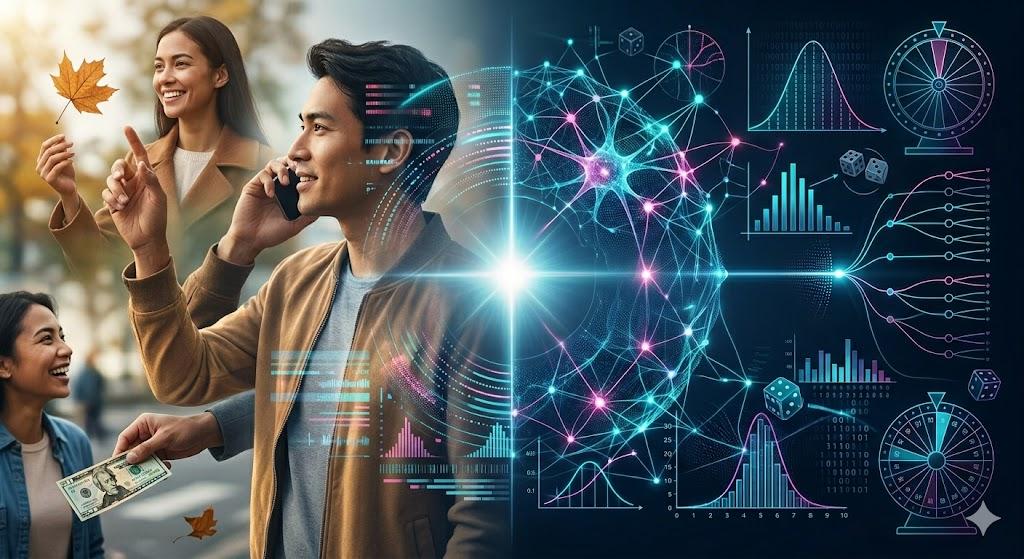
Have you ever had one of those days where the world just bends to your will? You wake up a minute before your alarm, hit every green light on your commute, and find a forgotten $20 bill in your jacket pocket. We call these “good days,” and we call the people who experience them consistently “lucky.” But from a scientific perspective, is luck real? Or is it merely a comforting human construct designed to find patterns in a chaotic universe?
The answer lies at a fascinating intersection of cognitive psychology, advanced probability theory, and evolutionary biology. What we perceive as a mystical force is actually a mix of brain chemistry, sensory filters, and behavioral patterns. Here is the surprising science behind why some people seem to have all the luck—and how you can start engineering your own fortune.
The Psychology of the “Lucky” Mindset
In the early 2000s, psychologist Dr. Richard Wiseman conducted a decade-long study to investigate the nature of luck. He found that self-proclaimed “lucky” and “unlucky” people live in entirely different psychological realities, even when exposed to identical environments.
The human brain processes roughly 11 million bits of information per second, but our conscious mind can only handle a tiny fraction of that. To cope, the brain relies on the Reticular Activating System (RAS)—a gatekeeper network of neurons that filters out “irrelevant” data based on what we care about.
Anxious or highly stressed individuals suffer from a narrowed visual field, meaning they are so focused on a specific worry that they miss unexpected opportunities. Conversely, relaxed, open-minded individuals have a broader focus. Their RAS is primed to notice the unusual, the fortunate, and the serendipitous. Ultimately, luck isn’t something that happens to you; it’s a cognitive filter. Lucky people simply notice more of the good things that are already happening around everyone.
The Mathematics of Chance: Probability vs. Perception
To a statistician, luck is just a dramatic misinterpretation of basic probability. In a world of billions of people, highly improbable events must happen to someone every single day. This is governed by the Law of Truly Large Numbers, which states that with a large enough sample size, any outrageous coincidence is almost certain to occur. When a massive mathematical anomaly happens to you personally, your brain labels it a “stroke of luck,” ignoring the millions of times the math didn’t align in your favor.
Our brains are fundamentally wired to find meaning in random sequences. Evolutionarily, tracking patterns helped humans survive. Today, this same neurobiology reacts intensely to the concept of chance. When we experience a “near-miss”—such as seeing a digital randomizer stop just one tick away from a grand prize—our brains release a massive wave of dopamine. This chemical hit creates a powerful urge to try again, tricking the brain into believing that a pattern is forming and that a winning streak is just around the corner.
Modern Leisure and the Evolution of Digital Entertainment
Our perception of luck has shifted significantly in the digital age. In a hyper-connected society where traditional, expensive milestones are increasingly difficult to reach, our psychological relationship with risk, reward, and entertainment has adapted. With shifting macroeconomic factors, modern consumers have become highly selective about how they spend their recreational time and capital. Data shows that as standard https://spinwinera.com/ across households, the demand for affordable, high-engagement digital experiences has skyrocketed. People are moving away from passive entertainment and looking for interactive ways to decompress.
This shift perfectly aligns with the intrinsic human desire to test one’s luck and boundaries. Instead of seeking luck in the physical world, millions of users now explore this dynamic through advanced gamification on modern interactive platforms. Whether it is through a clever digital reward system, a complex puzzle, or a simulated spin of a wheel, these premium virtual spaces leverage behavioral psychology to give players a pure, controlled environment where they can challenge their intuition. By blending cutting-edge visual design with random number generators, these digital hubs have transformed the ancient quest for good fortune into a highly accessible form of modern, tech-driven recreation.
3 Science-Backed Ways to Engineer Your Own Luck
If luck is largely behavioral, it means you can actively cultivate it. Behavioral science suggests you can tilt the odds in your favor by adopting three specific habits:
- Maximize Your Opportunities: Change your daily routine. Take a different route to work, read a book outside your usual genre, or strike up a conversation with a stranger. Expanding your network increases the mathematical probability of a lucky encounter.
- Tune Into Your Intuition: Lucky people act on their gut feelings. Neurologically, your “gut instinct” is often your subconscious brain recognizing a micro-pattern or a red flag before your conscious mind can articulate it.
- Practice Constructive Coping: When things go wrong, lucky people practice positive counterfactual thinking. Instead of thinking, “I’m so unlucky I got into a minor accident,” they think, “I’m incredibly lucky it wasn’t a major crash.” This mindset prevents the anxiety spike that narrows your focus, keeping your brain open to the next positive turn of events.
Ultimately, luck isn’t a magical aura or a gift from the universe. It is a synthesis of preparation, open awareness, and the courage to take a calculated risk when probability presents an open door.