
The Architecture of the Modern Hermit
Step outside right now and you’ll see a society operating in total psychological quarantine. Silicon Valley billionaires pitched us this glossy, borderless global village for twenty years. What we actually bought is a sterile wasteland of absolute solitude. Humanity essentially bargained away the beautiful, sticky chaos of dive bars and softball leagues. In exchange, we got a personalized algorithmic feed that agrees with everything we say. A massive vacuum emerged when the physical “third place” collapsed. Solitary digital consumption rushed in to fill the gap.
Anthropologist Natasha Dow Schüll diagnosed this structural trap years ago when studying Las Vegas slot addicts. She labeled this dissociative state the “machine zone.” Gamblers trapped in this loop do not actually care about hitting a jackpot. Their primary objective is simply staying in the zone—completely shielded from the terrifying unpredictability of other human beings. Your smartphone operates on the exact same psychological chassis. The social feed acts as a pocket-sized slot machine engineered to eradicate dead time. Inside this digital architecture, another person’s presence registers as a hostile interruption to a solitary flow state. We exist as highly efficient nodes in a network, stripped of the biological markers of actual connection.
Chasing the Durkheimian High
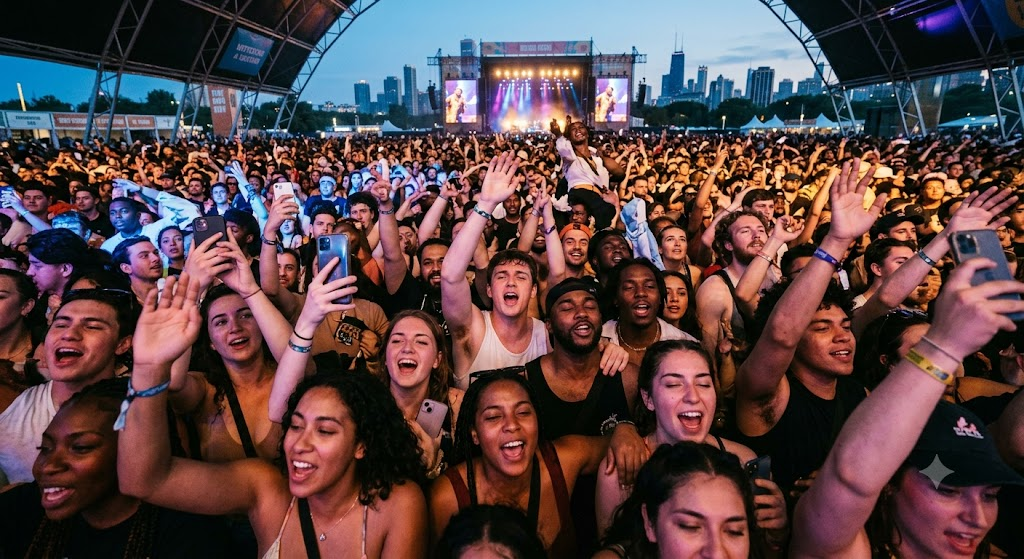
Look at the exploding ticket prices for live events today. A violent counter-narrative is obviously playing out in the market. Consumers are starving for what French sociologist Émile Durkheim labeled “collective effervescence.” Over a century ago, Durkheim observed tribes oscillating between mundane daily survival—the profane—and ecstatic, shared rituals—the sacred. Modern workers crave that exact same raw electricity. The average mid-level manager spends forty hours a week trapped in asynchronous Slack channels. That same professional will happily drop a thousand dollars to stand in the mud at a music festival. A massive, sweating crowd offers a neurological reset you cannot synthesize through a screen.
Symbolic anthropologist Victor Turner took this framework a step further with his concept of “communitas.” He understood that humans possess a desperate, hardwired need for temporary “anti-structure.” A stadium acts as a liminal threshold where the corporate vice president and the entry-level barista are reduced to absolute equals. Fans wear the same overpriced merchandise. Thousands of voices chant the identical anthems. The participants gladly surrender their rigid individual identities for the intoxicating relief of the collective. This phenomenon produces cascading psychological benefits. The immediate outcomes deliver massive tension relief. Long-term, people walk away from these synchronous gatherings with a fortified sense of social integration.
Manufactured Fate on the Green Felt
You do not need a massive stadium to witness this primal drive in action. The casino floor provides a perfectly localized laboratory for human synchrony. Walk past the rows of solitary video slots—where the silent “machine zone” reigns supreme—and listen to the chaotic noise erupting from the table games. Craps stands out as a masterclass in engineered communitas. Anyone looking into how to play craps quickly realizes the math is secondary to the sociology of the table. A single shooter throws the dice down the long, felt-lined runway. Almost everyone places their wagers on the Pass Line. That simple geometric placement structurally aligns their wallets with the success of the person throwing.
The dealer establishes a “Point,” instantly transforming a random number into a temporary, sacred totem. A contrarian might bet against the table, but they will immediately face quiet hostility from the group. The collective polices its boundaries rapidly to protect the shared vibe. Tension physically vibrates through the air when the shooter gets on a hot roll. Players who were absolute strangers ten minutes ago are now high-fiving. They strictly enforce superstitious rituals. The entire group groans in unison when the inevitable seven ends the run. This environment is loud, grossly inefficient, and entirely dependent on human physics. The friction is precisely the point. We do not just want to acquire chips. We desperately want to experience the narrative of a victory together.
The Biology of the Hive Mind
This drive goes far deeper than basic sociology or entertainment preferences. Our internal metronomes physically lock together the second we share a room and stare at the exact same thing. Lab data from recent concerts is wild—it proves that fifty thousand strangers will suddenly share identical heart rates and breathing patterns. Spikes in skin sweat actually map perfectly across the entire crowd. Your nervous system reads that massive biological mirror as the ultimate green light for safety. A chemical flood of oxytocin immediately follows. This hormonal wave crushes the low-grade panic of modern loneliness in seconds.
Psychologists distinguish this elevated state from casual group identification. Group identification is purely cognitive. It looks like buying a hat or checking a score on your phone. True identity fusion occurs in the mosh pit of a concert or the packed bleachers of a rivalry game. The individual genuinely feels that they and the crowd are one single, breathing organism. This explains the ferocious loyalty of sports fandoms. The capacity for extreme pro-group action multiplies exponentially when you strip away the personal ego and fuse it with the collective. Digital avatars can simulate the visual spectacle of an event, but they completely fail to trigger this biological syncing.
Paying the Irrational Premium for Friction
The financial markets already reflect this biological desperation. A glass rectangle simply cannot feed the human soul forever. Industry heavyweights in the gaming sector figured this out the hard way, realizing they absolutely had to drag kids out of their dark bedrooms and into packed arenas. That physical gravity is the only way to manufacture real emotional stakes. The catch? You have to hand over your personal autonomy to get that electric high.
Nobody actually likes standing in a two-hour traffic jam after a stadium gig, or smelling the stale beer someone just spilled on their sneakers. We subject ourselves to that specific brand of torture for one specific reason. The frictionless alternative—sitting alone in a quiet, climate-controlled apartment with a smartphone—is a fast track to spiritual death. Society will undoubtedly keep pushing us deeper into bespoke algorithmic realities. The smart money, however, knows that the human animal will always pay a steep, irrational premium to feel the physical electricity of the crowd.